
Thursday, November 5th 2026 · 4 min read
The African King Whose Journey Made the World Look Twice
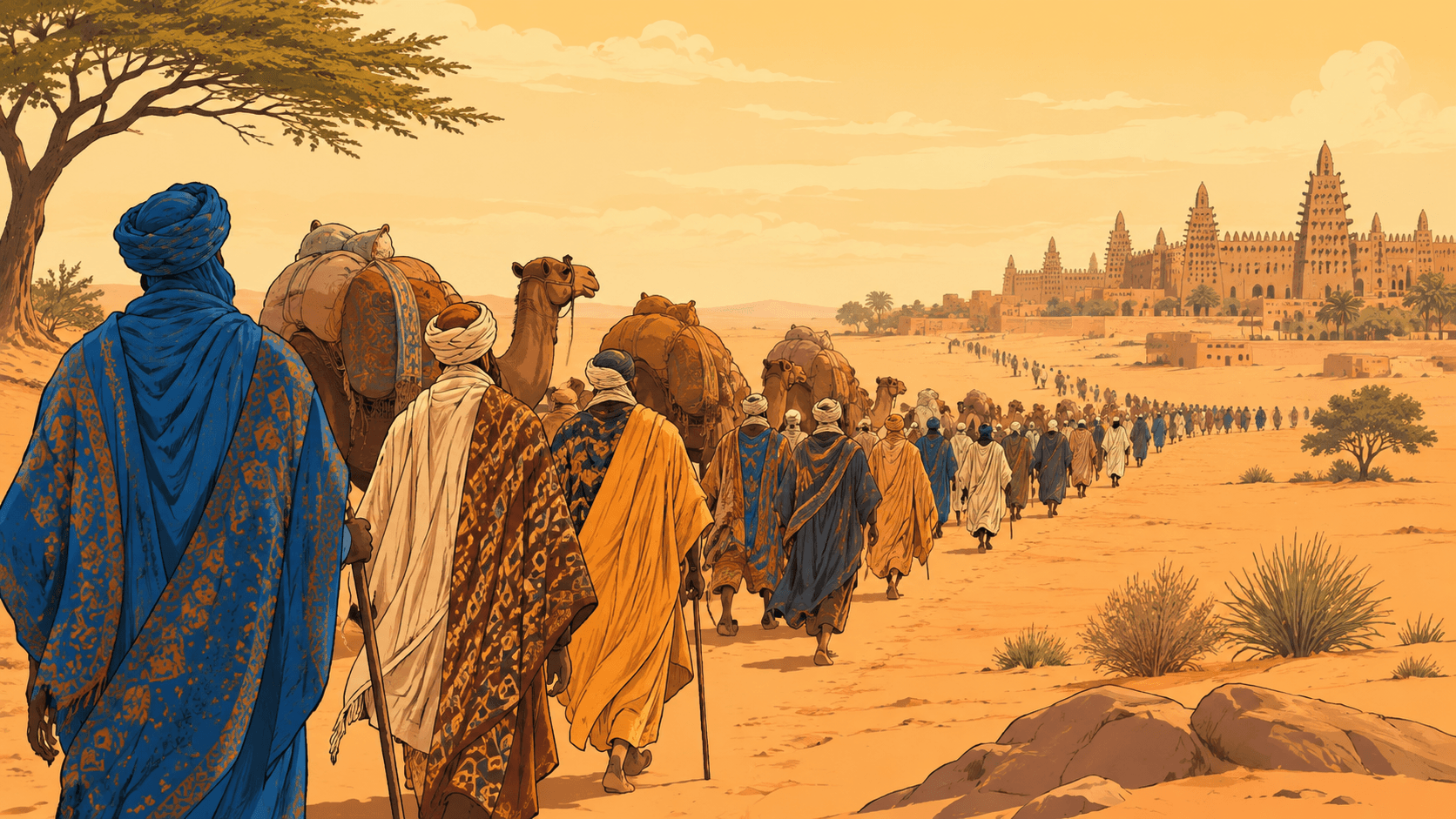
In 1324, an African king embarked on a journey that would become one of the most talked-about events in medieval history. He travelled with thousands of people, hundreds of camels and an extraordinary quantity of gold. His destination—Mecca. Somewhere along the way, his journey became a demonstration of the wealth, influence and possibilities of an African empire.
His name was Mansa Musa, and he was the ruler of the Mali Empire.
Long before his journey attracted attention across North Africa and the Middle East, Mali was already a formidable empire in West Africa. Established in the 13th century, under the leadership of Sundiata Keita, it grew into one of the largest and most influential political powers in the region.
Its strength was built on commerce, agriculture, military organisation and control of important trans-Saharan trading routes. Gold from the southern regions of West Africa travelled north, while salt, textiles and other commodities from the northern regions, moved south. These commercial networks connected Mali to markets across North Africa and the wider Mediterranean world.
By the time Mansa Musa came to power, around 1312, Mali was already wealthy. His reign, however, would take its reputation much further.
As a Muslim ruler, Mansa Musa undertook the Hajj, the religious pilgrimage to Mecca required of Muslims who are physically and financially able to make the journey.
But this was no ordinary pilgrimage.
An enormous caravan accompanied the emperor, consisting of soldiers, officials, servants and traders. Some accounts place the number of people in his procession at tens of thousands, although the exact figures remain difficult to establish.
The caravan travelled through the Sahara, making its way towards Egypt before continuing to Mecca. And when Mansa Musa arrived in Cairo, Egypt, in 1324, his presence caused quite a sensation.
He distributed enormous quantities of gold through gifts, charitable contributions and purchases. His generosity was so extensive that it reportedly affected the value of gold in Egypt. According to accounts recorded by the Arab historian Al-Umari, the influx of gold contributed to a decline in its market value that continued for years.
Think about that for a moment.
A king from West Africa arrived in one of the most important cities of the medieval Islamic world and brought so much gold into circulation that it disrupted the local economy. His journey was no longer just a religious undertaking, it had also become a diplomatic and economic encounter between two powerful regions.
It is easy to remember Mansa Musa primarily for his wealth. After all, stories of his fortune have earned him a place in popular conversations about the richest people in history. But reducing his legacy to gold would mean overlooking what his reign represented.
Mansa Musa governed an empire whose influence extended across vast territories. He supported Islamic scholarship, attracted scholars and architects, and invested in the development of important cities, particularly Timbuktu.
During his reign, Timbuktu grew in prominence as a centre of commerce, religion and intellectual activity. Its position along major trading routes made it an important meeting point for merchants, travellers and scholars.
Musa is also associated with the construction of the Djinguereber Mosque in Timbuktu, one of the city’s most recognisable historic structures. His patronage helped strengthen the city’s place within the wider intellectual and cultural networks of the Islamic world.
He returned with scholars, religious figures and architectural influences that contributed to the development of his empire. The significance of his reign, therefore, was not simply that Mali possessed extraordinary quantities of gold. It was that its wealth could support trade, diplomacy, education, architecture and cultural exchange.
In 1375, approximately five decades after his pilgrimage, a Spanish cartographer named Abraham Cresques produced the famous Catalan Atlas, a medieval map of the known world. Among its illustrations was a depiction of Mansa Musa seated on a throne, wearing a crown and holding a large gold nugget. The image was accompanied by a description of him as a wealthy and powerful ruler.
Consider what this means. An African king, ruling an empire thousands of kilometres away from Europe, had become important enough to feature prominently in one of the most remarkable European maps of the medieval period.
Mansa Musa had helped place Mali within the geographical imagination of a much wider world.
His journey did not introduce Africa to civilization, nor did it create Mali’s wealth. Those things existed long before his caravan crossed the Sahara. What his journey did was make it harder for distant observers to overlook the political and economic power that already existed in West Africa.
Mansa Musa’s story is a reminder that African history did not begin with European exploration, colonial encounters or the arrival of foreign traders.
Today, centuries after his death, his name remains associated with extraordinary wealth. He left behind a record of an Africa that was organised, prosperous, influential and deeply connected to the rest of the world.