
The Meeting in Europe Where Africa’s Future Was Bargained Over
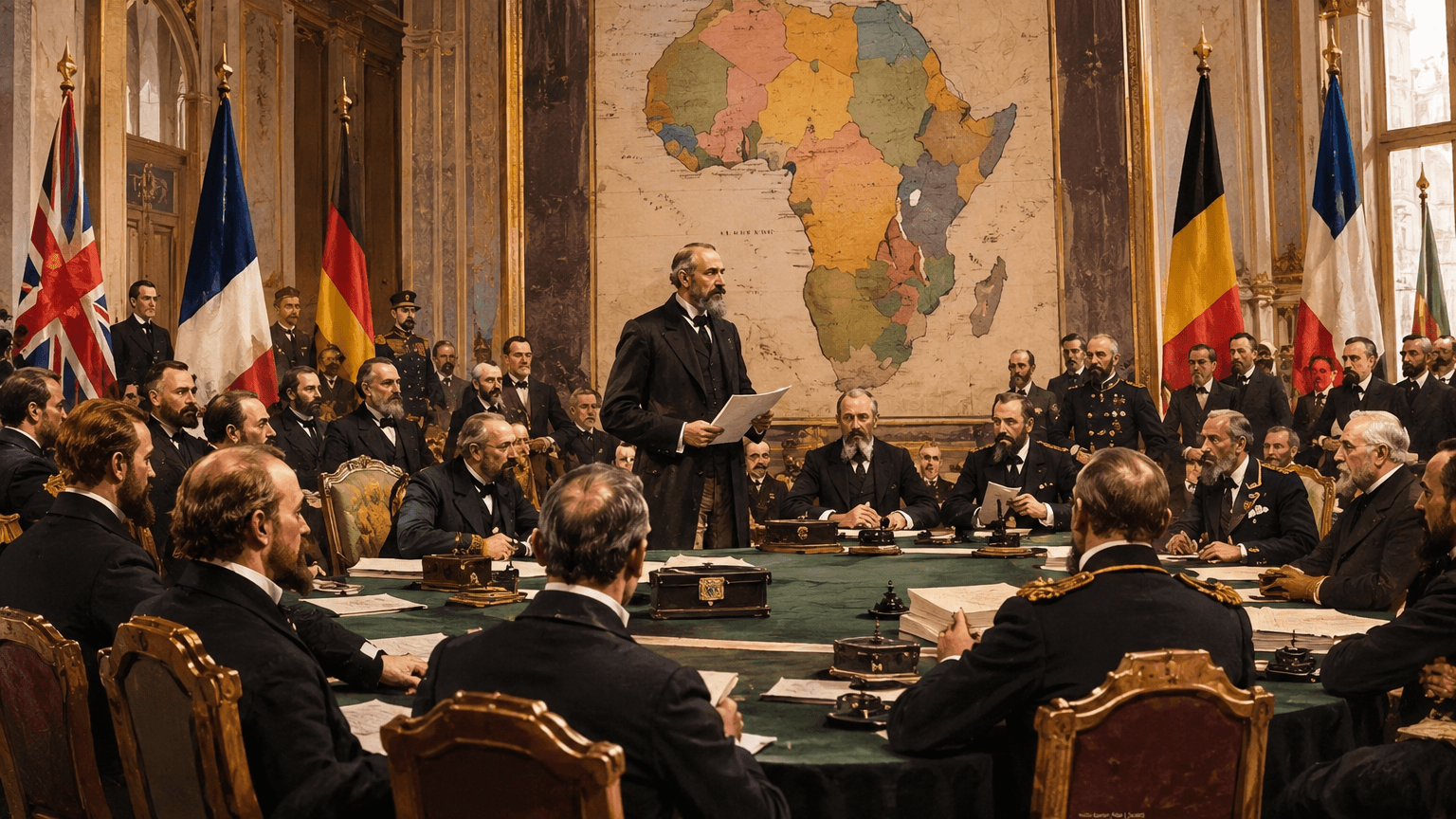
Imagine waking up one morning to discover that decisions about your home, your land and your future had been made thousands of kilometres away, in a room where nobody from your community was invited.
For Africa, this was not an imaginary scenario. It was part of a historical process that unfolded during the late nineteenth century, when European powers began competing aggressively for control of African territories.
Between November 1884 and February 1885, representatives of fourteen countries gathered in Berlin, Germany, for a conference that would become one of the defining moments in the history of European colonial expansion in Africa.
Think about that for a moment. African territories were being negotiated by foreign governments without African political leaders participating in the negotiations. The meeting would go down in history as the Berlin Conference. And the agreements they reached established the rules under which European powers would pursue territorial control over Africa.
Why Africa?
For centuries, African kingdoms and trading communities participated in extensive commercial networks involving gold, ivory, salt, textiles, agricultural products and other commodities. European powers had established trading posts and settlements along parts of the African coastline, while the transatlantic slave trade had already caused devastating disruption to African societies.
By the nineteenth century, however, European economic and political interests were changing. The Industrial Revolution had increased the demand for raw materials, new markets and investment opportunities. Africa’s natural resources, including rubber, palm oil, minerals and other commodities, became increasingly attractive to European industrial economies.
There was also growing competition among European nations for international influence and territorial power. Britain and France already had significant colonial interests in Africa. Portugal maintained longstanding claims and possessions along the African coastline, Belgium’s King, Leopold II, had ambitions in the Congo Basin, while Germany, under Chancellor Otto von Bismarck, hosted the conference.
The growing competition created tensions between European powers as their territorial ambitions began to overlap and something had to be negotiated.
The meeting in Berlin
On 15 November 1884, representatives of fourteen states assembled in Berlin at the invitation of German Chancellor Otto von Bismarck.
Among them were Britain, France, Germany, Portugal, Belgium, Italy, Austria-Hungary, Denmark, Spain, Netherlands, Russia, Sweden-Norway, Ottoman Empire, and the United States.
Their discussions focused on trade, navigation along major African waterways and the conditions under which European countries could establish territorial claims in Africa. They sought guarantees of commercial access. One of the major agreements concerned the Congo Basin, a resource-rich region in Central Africa whose extensive river network offered access to the African interior, while its resources, particularly rubber, ivory and palm oil, presented enormous commercial opportunities.
At the conference, European powers agreed that trade and navigation within the designated Congo Basin should remain open to all participating nations. This meant that no single European power should enjoy exclusive commercial access to the region.
The conference also established rules around the occupation of African territories. One particularly important principle was known as effective occupation. Under this principle, European powers could no longer rely solely on announcing a claim or raising their national flags to establish recognised control over coastal territories. They were expected to demonstrate an actual presence and exercise authority, while notifying other signatory powers of new coastal claims.
In practical terms, this encouraged European nations to move beyond their existing coastal settlements and establish control further into the African interior.
The elephant in the room was, however, was never addressed.
No African ruler, kingdom or representative was invited to participate in the negotiations. The people whose territories, political systems and commercial networks would be affected had no seat at the table.
The scramble for Africa
In the years that followed, European powers intensified their military expeditions, negotiated treaties with African rulers, established colonial administrations and fought wars to secure territorial control.
This period became known as the Scramble for Africa.
Britain expanded its influence across territories that would become Nigeria, Ghana, Kenya and Uganda, among others. France established control across West and Central Africa, including territories that would eventually become Senegal, Mali, Niger, Burkina Faso, Benin and Côte d’Ivoire. Germany established colonies in present-day Tanzania, Namibia, Cameroon and Togo, while Belgium consolidated control over the Congo Basin. Portugal maintained and expanded its colonial possessions in Angola, Mozambique and Guinea-Bissau.
These developments did not happen overnight. They unfolded through separate military campaigns, diplomatic negotiations, treaties and colonial administrations over several decades. By the beginning of the First World War in 1914, most of Africa had come under European colonial rule. Ethiopia and Liberia remained independent, although both faced considerable external pressures.
What happened to Africa consequently?
Before colonial rule, Africa was home to numerous kingdoms, empires and decentralised societies. These communities had their own systems of governance, territorial arrangements, trade networks and diplomatic relationships.
The colonial expansion frequently disregarded these existing structures as some kingdoms were conquered and incorporated into larger colonial territories. Others were divided between competing European administrations. Communities with longstanding cultural, linguistic and commercial connections found themselves separated by colonial boundaries. In other instances, different communities were brought together under a single colonial administration without regard for their existing political relationships.
However, it is important to understand that the borders were not all created in the same way. Some followed existing political frontiers or geographical features, while others reflected European negotiations and competing territorial interests. But still the consequences extended beyond geography.
Colonial administrations introduced new systems of taxation, labour, land ownership and economic production. African resources and labour were increasingly organised around the interests of European colonial economies.
In the Congo, for example, the territory granted to King Leopold II’s administration became the site of an extraordinarily violent system of forced labour and exploitation, particularly in the extraction of rubber.
The human cost of this expansion was enormous.
The map we inherited
Today, when we look at a political map of Africa, we see 54 internationally recognised countries with their own borders, governments and national identities. But the historical origins of many of these boundaries are connected to the colonial partition of the continent.
The borders that emerged during colonial rule continued to influence the political geography of Africa even after independence. The Berlin Conference represented a period in which foreign governments negotiated the conditions for expanding their control over an entire continent, with little regard for the authority and aspirations of the people who lived there.
The conference ended on 26 February 1885.But the consequences of the decisions, negotiations and territorial ambitions associated with that period would extend across generations.