
Sunday, November 8th 2026 · 2 min read
The Queen Who Rode Into the Stories of Northern Nigeria
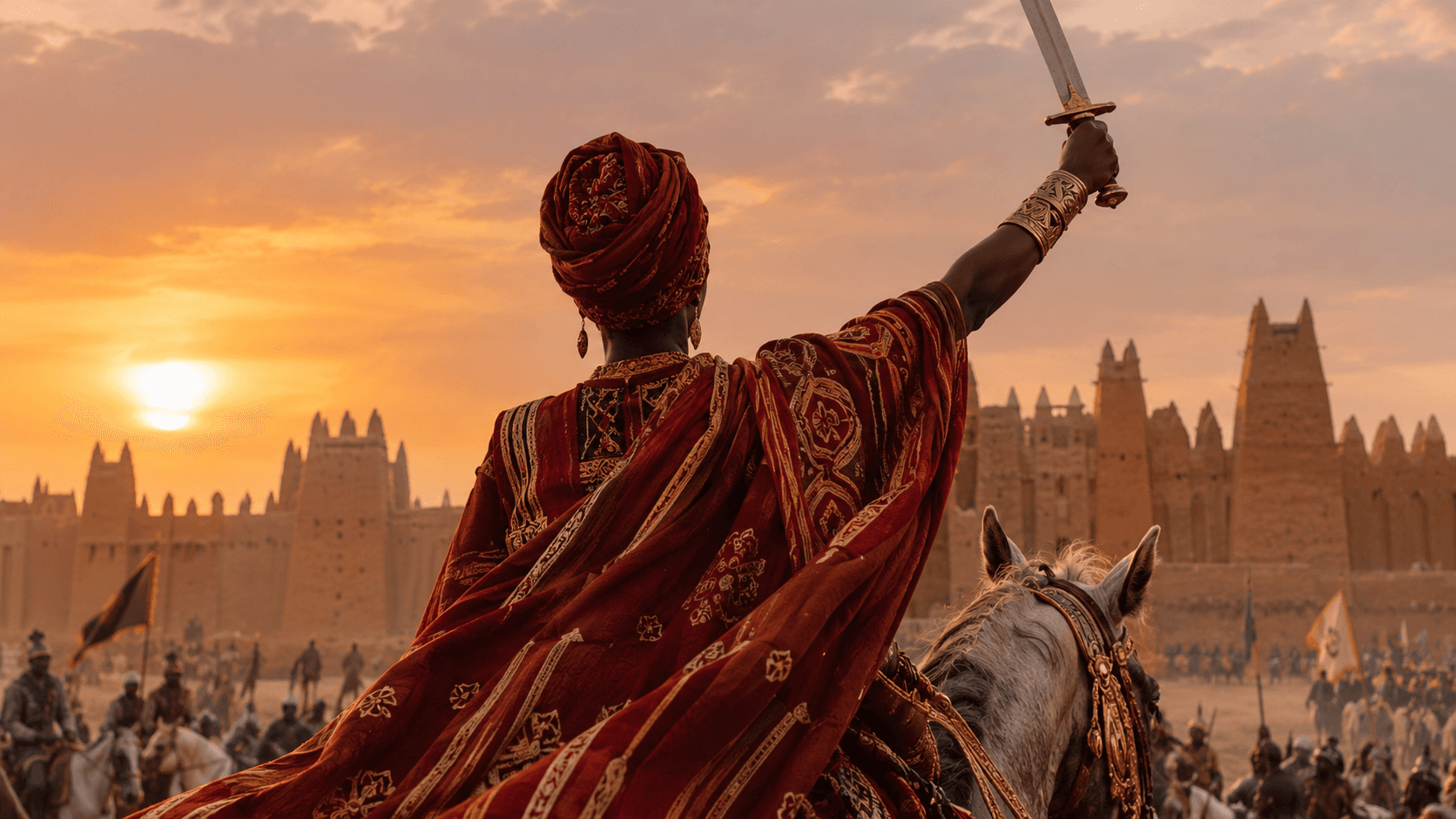
Imagine a kingdom where a woman could command an army, lead military campaigns and exercise political authority in a society where kingship was predominantly associated with men.
To understand Amina’s story, we must first understand Zazzau.
Zazzau was one of the historic Hausa city-states in the region now occupied by parts of Kaduna State in northern Nigeria. Its principal city, Zaria, was strategically positioned along important commercial routes connecting the southern regions of the Sahara, Hausaland and markets further south. Agricultural produce, textiles, leather goods and other commodities moved through interconnected trading networks, while political authority and military strength helped determine who controlled access to these routes.
Zazzau was part of a wider network of Hausa states, including Kano, Katsina, Gobir and Rano. These kingdoms competed, traded and maintained relationships with neighbouring territories. It was within this political and commercial environment that Amina’s story emerged.
According to accounts preserved in Hausa historical traditions, Amina grew up in a royal environment and developed an interest in military affairs. She participated in military campaigns before eventually assuming leadership. She is commonly remembered as a ruler who expanded Zazzau’s influence through military expeditions, bringing neighbouring settlements under its authority and demanding tribute from conquered territories.
One account in the Kano Chronicle describes Amina’s military expansion into territories as far as Nupe and Kwararafa. It also credits her with establishing a system through which conquered towns paid tribute to Zazzau. According to the chronicle, she had 34 years of conquests to her reign.
Much of what is popularly known about her comes from historical chronicles compiled centuries after the period in which she lived, alongside oral traditions passed down through generations. There are also conflicting accounts of her chronology.
The Kano Chronicle places her during the reign of Muhammad Dauda of Kano, conventionally dated to 1421–1438. However, traditions preserved in Zaria associate her with Bakwa Turunku, whose reign is generally placed in the late fifteenth or early sixteenth century.
These differences make it difficult to establish a definitive timeline.
Then there are the stories.
Popular accounts describe Amina as a queen who never married, personally led an army of thousands of soldiers and expanded her kingdom through relentless military campaigns. Even the famous earthen fortifications known as Ganuwar Amina, or Amina’s walls are associated with her name.
The uncertainty surrounding some details of Amina’s life does not erase her historical significance. Maybe one of the most interesting aspects of Amina’s legacy is what her story tells us about women’s participation in precolonial African politics. Historical narratives often presented warfare, political authority and kingdom-building as exclusively for men. Yet African history contains accounts of women who exercised political power and commanded armies. Amina’s story belongs to this history.
Whether every military achievement attributed to her can be established or not, her enduring place in Hausa history speaks to the significance attached to women leadership in the prehistoric Africa. She is remembered not simply as a woman who occupied a throne, but as a ruler associated with the military and territorial expansion of Zazzau.
Today, Amina’s name lives on in schools, historical discussions and popular culture across Nigeria. Her image is frequently represented on horseback, carrying a weapon and dressed for battle. She has become a symbol of courage, ambition and women’s leadership.