
Wednesday, September 16th 2026
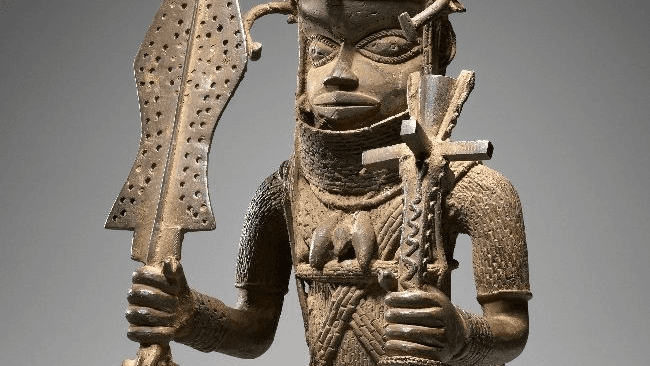
Artifact: Benin Bronze - Art, History, Ownership and the Complicated Journey of African Heritage
Imagine walking into your grandparents' home years after they are gone.
You notice the photographs are still hanging, the family heirlooms are still there, you just feel the stories still lingering in the walls.
Now imagine discovering that those objects have been scattered across distant places, admired by strangers who know what they are, but not who they meant.
That is one way to understand the journey of the Benin Bronzes.

Between the 13th and 19th centuries, master craftsmen in the Kingdom of Benin created extraordinary bronze plaques, commemorative heads, ivory carvings, and royal sculptures. They were not merely decorations. They recorded coronations, victories, royal lineages, spiritual beliefs, and the life of a kingdom whose history was cast into metal with astonishing skill.
Then, in 1897, everything changed.
During the British Punitive Expedition, thousands of these works were taken from the royal palace in Benin and dispersed across museums and private collections around the world. For decades, they became some of the most celebrated examples of African art.
But then, admiration and understanding are not the same thing.
A bronze plaque can be displayed behind glass, but you cannot display its meaning there as well.
This is because these works were never created simply to be seen, rather they were created to be remembered.

The conversation surrounding the Benin Bronzes has never been only about ownership. It is about relationship.
Who has the right to tell the story of a civilization?
Who decides what survives?
Who carries the responsibility of memory?
These are questions every generation must answer, not only for bronze, but for languages, traditions, songs, sacred places, and stories, because heritage is not lost all at once.
It disappears whenever meaning becomes separated from memory.
And maybe that is the greatest lesson of the Benin Bronzes.
A people can lose possession of their heritage but they must never lose possession of its meaning.
History does not truly belong to the hands that hold it.
It belongs to the hearts that still remember why it was made.