
Tuesday, October 6th 2026
What Will Our Imprint Be? RUTH8 and the Question of What We Choose to Preserve

Long before something becomes history, someone has to decide that it is worth remembering. Between what we inherit and what we leave behind lies the question of what is worth keeping.
What makes something worth preserving? Is it because it is old, because it belongs to us, or because it carries a story that deserves to be remembered?

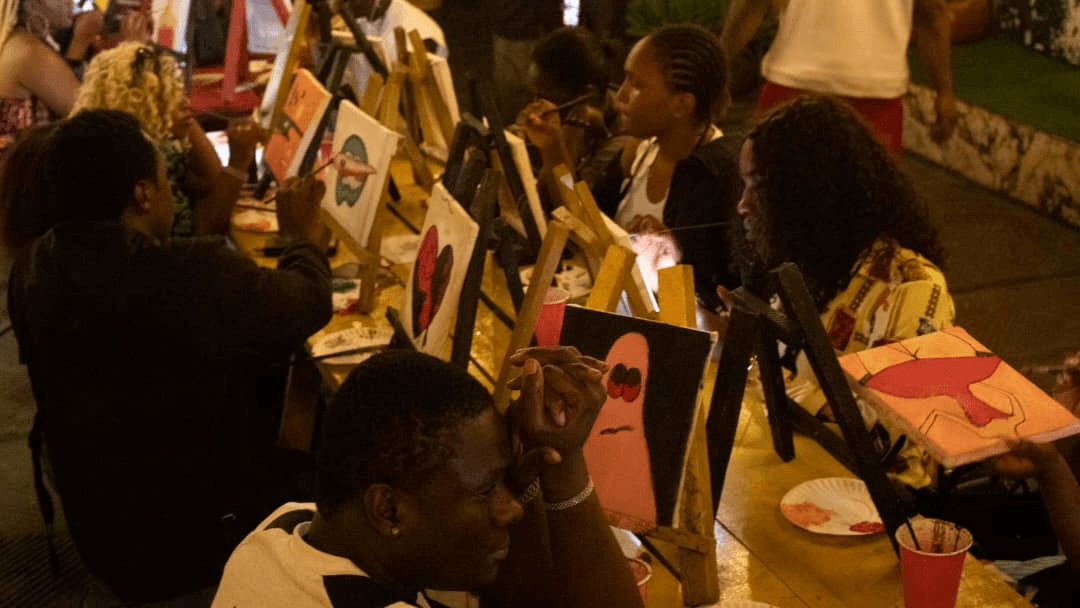
The third edition of RUTH8, held at Godwin Art Gallery under the theme “IMPRINT: Eat, Paint and Watch,” explored these questions. What appeared on the surface to be an evening of food, art and entertainment turned out to be a deeper conversation about culture, heritage, knowledge and what we choose to leave behind for the next generation.

The evening opened with the host, Cheejah, a model, model coach, creative director and video vixen, who set the tone for the gathering. She explained that RUTH8 was created to do more than bring people together for entertainment. It is also about connecting local creatives with their roots, encouraging learning andh creating a community where tradition, heritage and culture can be appreciated and shared.
“In as much as we're here to have fun, to eat, paint, and watch, we're also here to share knowledge, share information, understand our culture, understand our tradition,” she said.

For Cheejah, knowledge is an important part of creative growth. She encouraged creatives to learn from one another rather than assuming that talent alone is enough. She also drew attention to the way creatives in Lagos have been able to use their cultural identity as part of what makes their work distinctive, while encouraging creatives in Eastern Nigeria to place greater value on their own heritage.
Her point was not simply about competition between regions. It was about ownership. If people do not tell their own stories, someone else eventually gets to tell them for them.
“We don't feed people with what our culture looks like, we don't feed people with what our history and our heritage looks like.”

That thought connected directly to the theme of IMPRINT. Art, after all, can become a form of documentation. A painting can preserve a person, a place or a moment. Music can carry the voice of a generation. Photography can capture traditions that may no longer exist in the same form years later. Through creative work, stories that were never formally written down can still find a way to survive.
The evening's special guest, Mr. Godwin, CEO of Godwin Art Gallery and a Guinness World Record holder for the longest painting hours in the world, reinforced the importance of cultural identity and how far culture has taken him. Speaking from his own experience, he encouraged creatives not to abandon their roots in the pursuit of modern trends or outside approval.

His message was clear; know where you come from and do not be ashamed of it.
“Be yourself for yourself and greatness will come to you.”
Mr. Godwin's contribution brought the conversation back to authenticity. For him, culture should not be treated as something outdated that has to be abandoned before a person can become modern. Instead, heritage can become part of what makes a creative stand out.
He emphasised the importance of trying to infuse culture into our creative works and arts, making sure culture reaches home and creating opportunities that will shine a light on our culture.
The conversation continued with Kosi, who spoke about the relationship between creativity, storytelling and the generations yet to come. He described creative work as a bridge between yesterday, today and tomorrow.
“Yesterday brought about today; today will bring tomorrow,” he explained.

Those few words became even clearer during the questions around the three tables.
At Table 1: Heritage, participants were asked: “What part of your culture do you think deserves to survive?”
The discussion pointed to food and traditional agricultural practices as important parts of cultural identity. The loss of traditional farming practices was seen as more than a change in how food is produced; it also represents the loss of knowledge that has been passed down through generations.

At Table 2: Practice of Culture, the question was direct: “Can culture survive without being practiced?” The response was equally clear: culture needs to be lived. As one participant put it, “Culture cannot survive without being practiced.” Without continuous practice and proper transmission, cultural meanings can be forgotten, changed or misunderstood.

Then came Table 3: The Future/Inheritance, which asked: “What should the next generation inherit from us?”
The answer moved beyond physical objects and traditions. One of the key points was the fearlessness of the younger generation and their willingness to question things. Rather than accepting every tradition simply because it has always been done that way, the next generation should be willing to ask, Why are we doing this? Why is this a rule? What is the reason behind it?
In addition to what Table 3 delivered, Derrick said he would love them to inherit the ability to go further and evolve.
That perspective added another layer to the idea of preservation. Preserving culture does not necessarily mean preserving everything exactly as it is. It can also mean understanding where a tradition came from, questioning what needs to change, and intentionally keeping what still carries meaning and that is what made IMPRINT more than just a theme.

When the convener, Derrick, was asked what makes something worth preserving, he believed it was value. He also said that whatever you own or do, and you understand, has value.
He pointed out that what is called value may be different from what others call value.
“What a white man calls value may not be what a black man calls value.”
It became a conversation about what we leave behind.
But preservation does not happen automatically. Someone has to create, someone has to document, someone has to practise, someone has to teach and someone has to care enough to pass it on.

As the conversations unfolded, the crew worked on their assigned inspo pictures, turning the painting session into an opportunity to create memories while the Godwin Art Gallery (GAG) masquerade added to the evening’s entertainment.
RUTH8's third edition therefore left its audience with more than an evening of eating, painting and watching. It offered a reminder that culture remains alive when people choose to understand it, express it and share it.

Perhaps an imprint is not simply what we inherit from those before us.
It is also what we decide is worth carrying forward.
What will our imprint be?